

This article was originally published on the Game Developer website on December 12th, 2016.
I rephrased most of the article in 2025.
Introduction
|
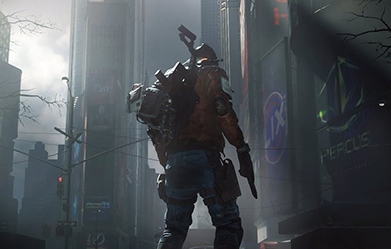
I played Tom Clancy's The Division extensively. Because my friends couldn't match my pace, I often found myself roaming the Dark Zone alone for hours. It was a harsh experience as groups of players rarely hesitated to ambush my character, and lone wolves were encouraged to do the same the moment my attention slipped. Over time, I developed habits to remain as invisible as possible - and I eventually realized that many of these habits were directly inspired by my training as an Alpine Hunter in the French Army. Of course, I cannot discuss certain aspects related to squad tactics or broader strategy, as doing so would violate military NDAs. However, camouflage techniques are widely known and thoroughly documented on specialized websites. In this article, I would like to shame some of this knowledge and examine how video games either leverage camouflage principales to create stealth gameplay - or deliberately ignore them to provide clearer feedback to players. |
|
A brief History
Wikipedia defines camouflage as “the use of any combination of materials, coloration, or illumination for concealment, either by making animals or objects difficult to see (crypsis), or by disguising them as something else (mimesis).”
Most animal species have developed crypsis or mimesis through evolution to avoid being detected by predators - or to ambush prey. Military uses of camouflage were relatively rare before the 19th century; one of the earliest examples dates back to the Gallic Wars, when reconnaissance ships were painted Venetian blue to better blend into the sea.
|
In the 19th century, the British Army was the first to officially abandon bright, ornamental uniforms in favor of khaki attire, which was better suited to colonial environments and offered improved concealment. Camouflage techniques only became widespread during World War I, when the French Army formed a dedicated camouflage corps. Interestingly, the word camouflage originates from Parisian slang meaning “smoke blown into someone’s face.” Today, camouflage techniques have evolved alongside detection technologies. Ships are built with materials designed to reduce heat signatures, while modern military uniforms (such as Canada’s CADPAT) are procedurally patterned to disrupt recognition by advanced detection systems. In 2003, researchers at the University of Tokyo even demonstrated an optical “invisibility cloak,” suggesting the first steps toward universal mimesis-based camouflage. |
|
In this article, I would like to shame some of this knowledge and examine how video games either leverage camouflage principles to create stealth gameplay - or deliberately ignore them to provide clearer feedback to players.
The French Army uses the mnemonic term FOMECBOT to teach the core principles of the camouflage. Several variations have emerged since my services ended, but I will only focus on the original principles I learned.

Shapes and colors
|
Shapes and colors probably are the most important principles of camouflage. Historically, military uniforms were brightly colored to glorify soldier and attract new recruits. However, natural environments are composed of subtle and specific color palettes that rarely match such uniforms - making soldiers easy to spot. Beyond color, the human silhouette itself stands out strongly against most background. Humans instinctively look for other human shapes, which is why modern uniforms rely on disruptive patterns to break up recognizable outline - rather than flat colors. |
|

As a stealth mechanic
In most stealth games, NPCs start detecting the player character as they enter in their perception shapes. Some titles go further. Several Metal Gear games, for example, prevent NPCs from perceiving the player character based on the environment and the outfit they were. These systems meaningfully influence routing choices - increasing both the player agency, and the depth of the game.
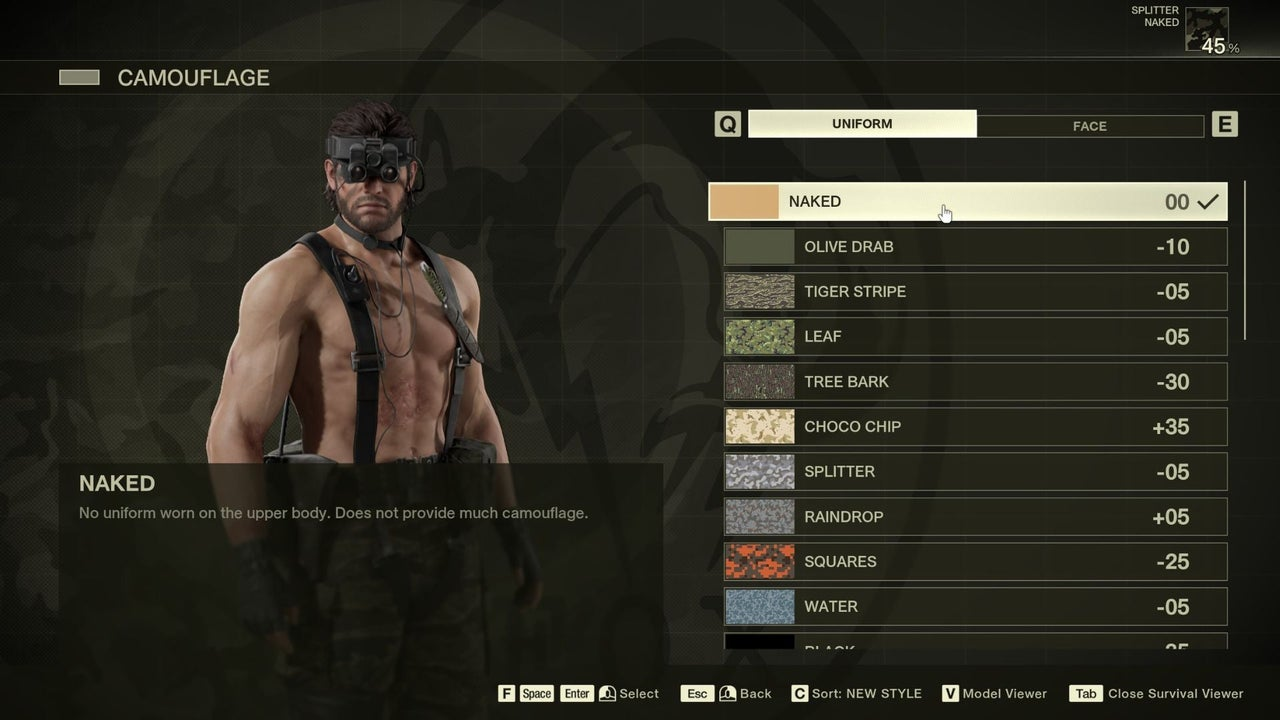 Metal Gear Solid Delta: Snake Eater
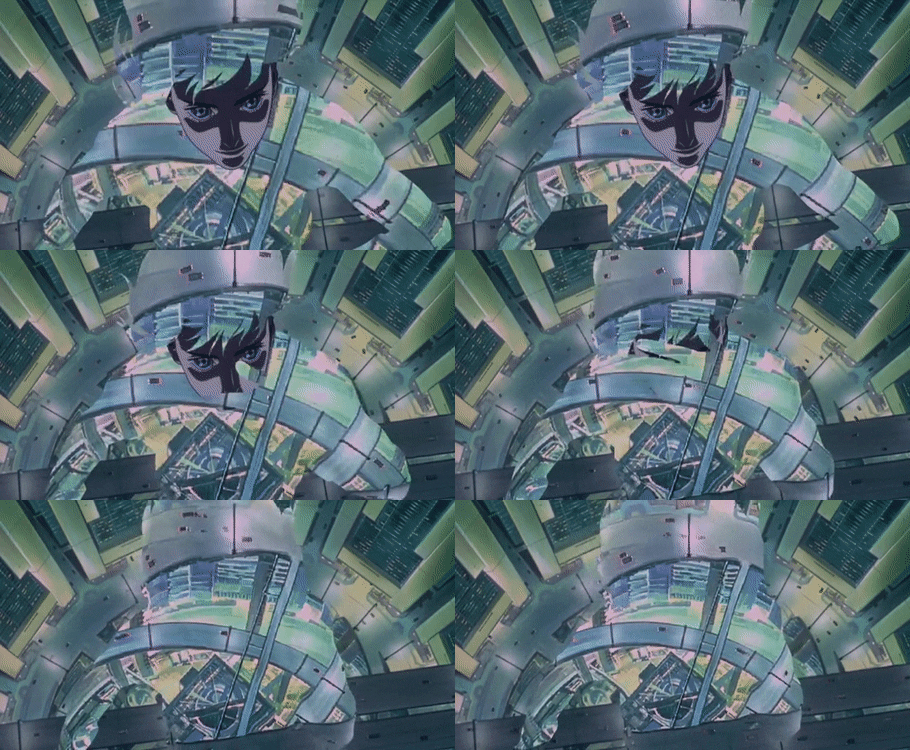
The Metal Gear series is also well-known for its camouflage devices that render the player character nearly invisible. similar mechanics appear in games like Ghost in the Shell: First Assault, and Aliens vs Predators. Because invisibility grants a major advantage (especially in multiplayer games) these systems are usually balanced through restrictions. A typically example is the inability to become invisible when the character moves.
The Hitman series approaches camouflage from a narrative perspective: the social stealth. Environments establish context, while Agent 47's outfine deines whether his presence is tolerated. The challenge isn't to remain concealed - but to justify the behavior of the player character. A suited stranger carrying a briedcase in a private villa draws suspicion, while a disguised repairman blends in naturally.
As a player feedback
|
Sometimes, designers intentionally violate camouflage principles to guide the player, or to provide them with an explicit feedback. Highlighting interactive elements with contrasting colors allows player to identify points of interest from a distance. Mirror's Edge is an excellent example: the gameplay is fast - yet, the player never gets confused. Another good example is the contaminated loot bag in The Division's Dark Zone. It clearly signals whether a character is carrying valuable items - incentivizing risk-taking and conflict. Ironically, this feedback encouraged me to ignore low-value loot to remain inconspicuous while increasing the tension around high-end extractions. As Peter Angstadt points out, color alone is often insufficient: saturation and brigthness are equally important to void visual confusion - especially in varied lighting conditions, and for players who suffer from color blindness. |
Motions, sounds, shadows and glares
|
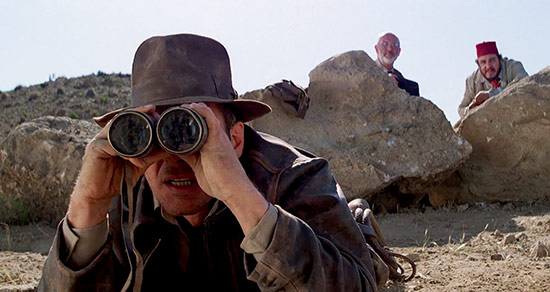
Mouvement is one of the strongest visual attractors. Any sudden or broad motion can reveal a concealed unit - regardless of coloration. Remaining perfectly still requires far more discipline than expected. Shadows can also betray a position, especially near corners or obstacles. Contrary to popular beliefs, shadows exist even in night or interior environments due to artificial light sources. Finally, reflective surfaces (such as scopes, watches, or metal insignia) can produce glares that immediately draw attention, a trop famously illustrated in Indiana Jones and the Last Crusade. |
|
As a stealth mechanic
In games, motion and sound are often tied together: the faster the character moves, the more noise they generate. This mechanic is particularly effective in stealth game, where developers want to put the player under pressure and challenge their ability to demonstrate self-control. Stealth survival games like Alien: Isolation excel here. However, I believe that VR can have the potential to create an unprecedented immersion. Indeed, I would be really interested in experimenting with headsets such as the PSVR 2: not only it can detect head movements, but also eye blinking. The Weeping Angels can become a reality!
Shadows are rarely used per se, due to camera limitations and variable graphics settings. However, if we consider a broader definition, many games still leverage light and dark zones to define safe dans dangerous areas. [EDIT 2025] The illumination was a core feature of the Splinter Cell series, and I had the honor to design a modern and fully dynamic version for Assassin's Creed: Shadows. Check it out!
Glare is mostly used in multiplayer shooters. The VFX appears when a character aims with a scoped weapon - betraying their position. This simple but efficient mechanic then challenges both the player's precision and reflexes. Hence a higher skill ceiling to keep progressing, and to further differentiate players.
As a player feedback
Motions, sounds and glares are widely used to draw attention: birds taking flight, rustling bushes, blinking lights, or even animated collectibles. Left 4 Dead is a great example I like. The game only takes place at nights, and mostly in interiors. This choice certainly adds to the ambient atmosphere - but it also lets the developers strategically light areas to naturally guide players through dark environments.
Here a playthrough I recorded from the all-first mission of the campaign "No Mercy":
First mission of the campaign No Mercy from Left 4 Dead
It's harder to find games that exploiting shadows to provide players with a feedback. However, I do remember a specific mission from The Division where projected shadows help the player timing the arrivals of NPCs.
Tracks and smell
Tracks and smell remain two of the most overlooked aspects of camouflage in video games, even though they offer significant untapped design opportunities.
Tracks refer to any evidence of priori presence: footprints, shell casings, broken branches, or open doors. They introduce a temporal dimension to stealth, especially during long infiltrations or pursuits.
In real life, camouflage also relies heavily on smell: odors from food, sweat or gunpowder are easily detected. This is especially true for animals. Studies suggest dogs possess vastly superior olfactory capabilities, and could be able to detect scents from miles away - with some reports suggesting distances up to 40 miles under ideal conditions (65 kilometers).
As a stealth mechanic
|
Tracks are commonly used in stealth games to trigger NPC reactions. Discovering bodies or footprints heightens tension and forces players to consider long-term consequences. However, such mechanics can raise concerns about fairness of - particularly when player characters lack the ability to hide bodies or avoir leaving footprints. Hitman: Blood Money offers a compelling take through its notoriety system. The player behavior (and the presence of witnesses) influences how recognizable Agent 47 becomes in future missions, creating persistent consequences across the game. In this sense, tracks are not limited to physical evidences: they can take many forms of persistence, which is where I believe more interesting opportunities can emerge. Likewise, smell-based mechanics are rare, largely due to the challenge of effectively conveying olfactory information to the player. However, there are still interesting ways this dimension could be meaningfully implemented. Tenchu Z stands out by allowing NPCs to detect the player based on the scent of blood, combining olfactory detection with temporal build up. This is a feature that I particularly appreciate, as it discourages players from assassinating every NPCs, and as it encourages more deliberate, restrained playstyles. [EDIT 2025] Since then, I've had the opportunity to play Kingdom Comes: Deliverance II. The game aims to recreate the everyday life of a squire in feudal era, where hygiene was a significant concern. The developers chose to model hygiene as an actual attribute - explicitly feeding it back to the player, and allowing NPCs to quite literally smell the player character. |
|

As a player feedback
|
Some titles (such as The Witcher 3: Wild Hunt) give the player character to follow markers that represent either footprints, or a scent trail. However, the experience remains shallow as there's little challenge in such an activity. Other titles (such as Dead Space or Skyrim) use tracks as an environmental storytelling tool. Blood trails, scorch marks, or corpses then hint unseen dangers. |
|

Summary
Camouflage encompasses principles tied to all human senses - not just vision. While animals have relied on these techniques for millennia, camouflage only became a formal military discipline in the late 19th century.
Video games adapt these principles to support stealth gameplay, sometimes simulating them faithfully and sometimes intentionally breaking them to improve player feedback. Certain senses, such as smell, remain underexplored due to design and communication challenges.
Emerging technologies like VR may offer new opportunities to renew stealth gameplay and create more immersive experiences. This is definitely a topic I'm interested in, and I'll soon brainstorm some prototype ideas!